



our history
The old house was built in 1841
Built by the shopkeeper Matthías Jónsson Mathiesen, and he built the southern house a year later. Both houses still stand in their original form in the Viking Village cluster and are commonly referred to as Fjaran or Fjörukráin. Over time, the houses have served many purposes: a small shop, a department store, general storage, a smithy, and a sailmaking workshop. The first classes in maritime navigation were also held there. Additionally, the buildings served as a horse stable, a barn, and later as a pharmacy.
During the first part of the last century, the Old House was connected to the fishing trawler industry here in Hafnarfjörður, which later flourished and contributed to the town's thrift and development. On February 7th, 1985, the Hafnarfjörður city council voted to demolish the house after receiving the building commission's consent. The building commission, however, sent the matter for consultation to the National Committee of Building Preservation, which unanimously voted against the demolition of the house. At that time, the city sold the house to Viktor Strange and Harrý Hólmgeirsson. They rebuilt it and finished the job in 1986. That same year, they opened the restaurant Fjaran with grandeur in the house.
In 1990, they sold the company to Jóhannes Viðar Bjarnason, who changed the name to Fjörukráin and opened the Old House Viking Times restaurant on May 10th that same year, after a few changes. He introduced many novelties to his clients that had never been seen in restaurants, neither here in Hafnarfjörður nor elsewhere in the country. Jóhannes started connecting songs and food, and held many days and events connected to various countries. He dressed up his servers and singers in the national costumes of the respective countries. Among the great events that he held were French days, Swiss days, Austrian, Danish, Russian, Egyptian, Faroese, and Greenlandic days. Often, artists from the respective countries participated in the events, or local talents from those countries were involved. From the above, one can see that many foreign artists have visited Fjörukráin over the years, not to mention the local artists, singers, and musicians who have provided entertainment for guests at the Viking feasts to this day.
A year later, on May 10th, 1991, the Viking feasts began in a tent erected just south of Fjörukráin, the Old House. This date, May 10th, has become a milestone date that is used for the introduction of novelties at the center for each year and the years to come. On this day, many great parties were held to introduce the center's friends to the changes and new initiatives in our operations. Thus, the center has grown step by step; Fjörukráin, which started with 60 seats, now has seats for 350 guests. The facilities now comprise two restaurants standing side by side and the Hotel Viking.
The operation has been developed in stages, step by step, based on the financial status at each stage. When we built the tower, not everyone was happy, and there was a great debate in the newspapers and elsewhere, but it was built and has since become one of the main symbols of Hafnarfjörður's skyline. Another novelty was introduced: the possibility for people to go whale watching and take fun trips from here, and the ship Fjörunesið was purchased for that purpose. Unfortunately, we were ahead of our time with those types of attractions, as whale-watching tours had not yet become as fashionable as they are today. The sale of alcohol was banned on board the ship. This business was abolished after two tough years of trying. You can say the timing wasn't right for this business on our side. Just a few years later, whale-watching and ocean-fun tours had become a thriving, popular business.
The Hafnarfjörður steel smithy was later acquired by our company and converted into the West Norden Guesthouse. The rooms were decorated with woodcuts and pictures from various historic sites in our neighboring countries, Greenland and the Faroe Islands. Of course, Icelandic handicrafts were held in great esteem there also. On the first floor of the house was the West Norden Culture house and shop. There were also workshops for handicraft artists who sold their goods there. As with the boat division, this did not work out financially, and the operation was changed into a more lucrative business.
The guest house was changed into a hotel, and rooms were added. The handicraft shop was converted into the hotel's breakfast room, and a now-very-popular cave was built into the cliff beside the hotel as an extension of the breakfast room. We now have 42 modern rooms in the hotel with all necessary amenities. Many things have been tried, some worked out well, others not so well, which is often the case in business.
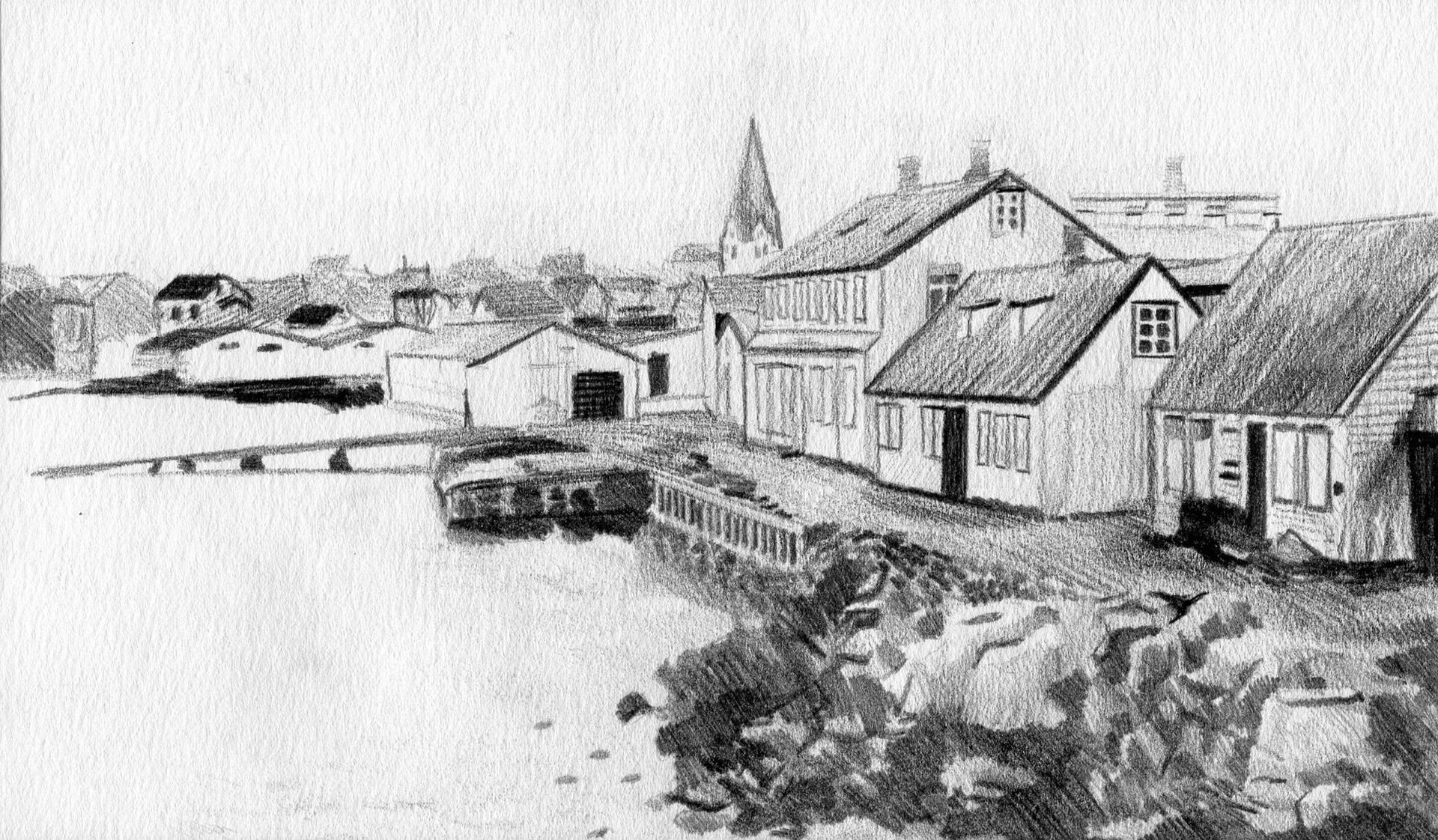
Fjaran 1910